
Corsica — France
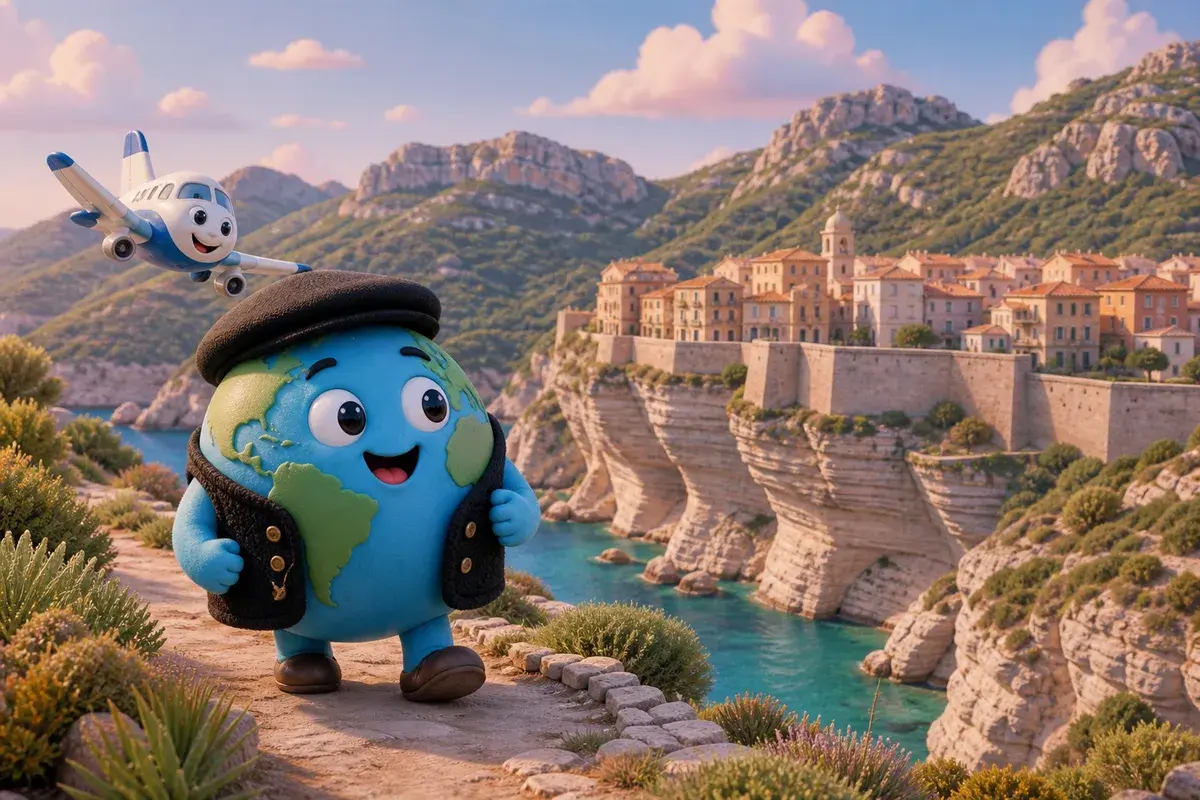
Corsica is a French island in the western Mediterranean, but geologically it is a mountain range that happens to have beaches. Our readings on the Ajaccio side give 30.2 °C in July and August, 604.9 mm of rain across the year, and an autumn peak of 109.8 mm in November alone.
Free — no account needed. The assistant builds a full proposal: itinerary, honest budget, map and booking links.
Why go
Most Mediterranean islands are coastlines with an interior. Corsica is the reverse: a granite spine runs the whole length of it, high enough to hold snow into spring, and the sea is what happens at the bottom of the valleys. That geography governs everything, from the language and the herding villages to the fact that two points close together on a map can be a long, slow drive apart. The coast alternates red porphyry cliffs, deep gulfs and beaches of pale sand, and the interior offers chestnut forests, pierced needles of rock and rivers with swimming pools cut into them.
It rewards travellers who like driving, walking and eating simply, and who accept one base per region rather than one base for the trip. It is a poor fit for anyone who wants nightlife, museums or a resort that organises the days for them. Public transport is thin, prices are firmly above the French average in August, and the most photographed beaches are reached by roads that were never designed for the traffic they carry.
Month-by-month climate
The coastal figures are gentle and the seasons are sharply drawn. January is the coolest month, 14.7 °C by day and only 5.2 °C at night, which surprises visitors who expect a mild Mediterranean winter. Spring warms fast: 17 °C in March, 19.5 °C in April, 22.6 °C in May, then a jump to 27.8 °C in June.
July and August tie at 30.2 °C and are genuinely dry, 7.9 mm in July over a single rainy day, 18.2 mm in August. September stays warm at 27.1 °C but the rain returns, 50.1 mm, and October holds 24 °C with 61.4 mm. The wet month is November: 109.8 mm over 11 rainy days, followed by 88.8 mm in December. Across the year we measure 604.9 mm over 66 days with at least 1 mm, so the water arrives in heavy bursts rather than in drizzle.
One caveat matters here more than anywhere. These numbers describe the coast. Inland and at altitude, expect markedly cooler nights, storms building in the afternoon in summer, and passes that can close in winter.
| Month | Avg. high (°C) | Avg. low (°C) | Rainfall (mm) | Days ≥ 1 mm | Days ≥ 5 mm |
|---|---|---|---|---|---|
| Jan | 14.7 | 5.2 | 45 | 7 | 3 |
| Feb | 15.6 | 5.5 | 60 | 7 | 3 |
| Mar | 17.0 | 6.2 | 46 | 6 | 3 |
| Apr | 19.5 | 8.6 | 37 | 5 | 2 |
| May | 22.6 | 12.4 | 52 | 5 | 3 |
| Jun | 27.8 | 16.9 | 28 | 3 | 2 |
| Jul | 30.2 | 19.1 | 8 | 1 | 0 |
| Aug | 30.2 | 19.2 | 18 | 2 | 1 |
| Sept | 27.1 | 16.2 | 50 | 5 | 3 |
| Oct | 24.0 | 13.1 | 61 | 6 | 4 |
| Nov | 19.0 | 9.1 | 110 | 11 | 6 |
| Dec | 16.1 | 6.2 | 89 | 8 | 5 |
Source: Meteostat — Corse (France) station, 5.1 km away, 10 sample years. Monthly totals rebuilt from daily averages.
When to go
The window opens in late May and runs to mid-June, then reopens in September. You get 22.6 °C in May, 27.8 °C in June and 27.1 °C in September, open mountain roads and a sea that has had time to warm by the end of summer. July and August bring the heat and the crowds together, plus fire-risk closures on some trails. October is still warm but wet, and November, at 109.8 mm, is the month to avoid for a driving holiday.
The most favourable months, on these records
- May
- June
- September
- October
What to see in 2, 4 and 7 days
In 2 days
- Ajaccio's old town and its museum of Italian painting, then the fish market early on the second morning.
- Drive out to the headland west of the city for sunset over the offshore islets.
- Second day, head north to the red creeks of the Piana coast and walk one clifftop path.
- Swim at a cove below the corniche road rather than at the signposted main beach.
In 4 days
- Day one in Ajaccio: the old town, the museum of Italian painting, the fish market at first light and a swim below the corniche road.
- Day two north to the red creeks of the Piana coast, one clifftop path walked slowly, and a cove reached on foot rather than from a car park.
- Day three in the far south: white limestone cliffs, the citadel town perched above them, and a harbour tucked into a fjord-like inlet.
- Day three, late on: the beaches of the south-east coast, taken before the car parks fill or after they empty.
- Day four inland at Corte for the citadel and the museum of Corsican life, then one of the two valleys behind it, up to a mountain lake or a river pool.
- Spread the north-to-south drive over two of those days, never one: the roads are slower than the map suggests.
In 7 days
- Days one to three for Ajaccio, the Piana creeks and the far south, moving base only once.
- Day four loops the Cap Corse peninsula, with its Genoese towers, terraced vineyards and small working harbours.
- Day five sleeps in the north-west, for the citadel town and its bay of pines, with a boat out to the protected marine reserve where landing is restricted.
- Day six crosses the Bavella pass for the needle-shaped peaks and a short stage of the island's long-distance trail.
- Day seven reaches one of the wild northern beaches by boat or track rather than by ordinary car.
- Book one evening around Corsican charcuterie, sheep cheese and chestnut flour, the island's real menu.
- Leave a full day unplanned: mountain weather rearranges itineraries more often than you expect.
Getting there and around
Ajaccio (AJA) is 5 km from the centre, a short bus or taxi ride. Figari (FSC), 55 km away, serves the southern tip and is the better entry point for the far south. Calvi (CLY) is 68 km off and covers the north-west. Ferries also run from the French mainland and from Italy, which is the sensible option if you want your own car. On the island, a car is close to essential: the rail line is short and scenic rather than useful, and bus services outside the main corridors are sparse and seasonal.
Nearest airports
- AJAAjaccio Napoleon Bonaparte Airport5 km from the centre
- FSCSud Corse Airport55 km from the centre
- CLYSainte Catherine Airport68 km from the centre
Budget
Country price level compared with France : on a par
Price index for restaurants and hotels, France = 1000, from European purchasing power parities. It is a country average: it says nothing about one hotel in particular.
Estimates only. Corsica prices like mainland France, and above it in summer, because almost everything sold on the island has crossed the sea first. In August, 100 to 200 € is the usual bracket for a comfortable double, and roughly half that in May or October. For meals, count on the order of 35 to 60 € per person per day, less if you shop at village grocers. The two variables that really move the total are car hire and the vehicle ferry, both of which reward booking months ahead.
Common mistakes
- Planning distances from the map. Mountain roads, hairpins and slow-moving campervans can double a journey time you thought was settled.
- Booking one hotel for the week. The island is best covered in two or three bases, north, centre and south.
- Treating the long-distance trail as a holiday walk: it is a demanding high-mountain route with real exposure.
- Arriving in August without a reserved car, or with a vehicle ferry left to the last minute.
- Expecting a dry late autumn. November alone brings 109.8 mm over 11 rainy days.
Frequently asked questions
Can I visit Corsica without a car?
It is possible but limiting. The coastal towns are linked by seasonal buses and a short railway, and boats connect several ports in summer, which is enough for a beach-and-town trip. Almost everything else, the mountain passes, the river pools, the remote coves, assumes a vehicle. If you skip the car, plan to stay in one or two towns rather than circling the island.
Is September a better bet than July?
For most travellers, yes. September still gives 27.1 °C, with a sea warmed by the whole summer and far fewer people on the roads and beaches. The trade-off is rain: 50.1 mm against 7.9 mm in July, usually in short heavy episodes. Pack a light waterproof, keep one indoor option per region, and the month is hard to beat.
Updated on 21 September 2026