
Petra — Jordan
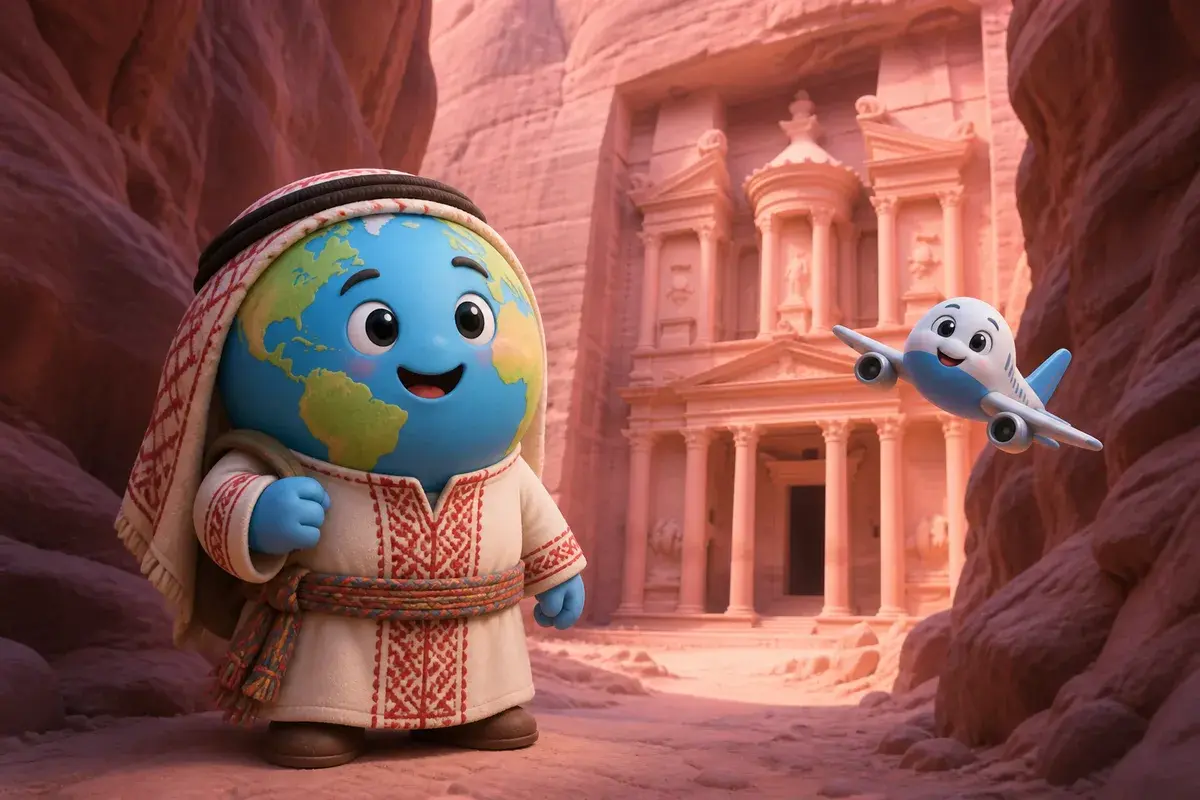
Petra spreads across a whole valley rather than standing as a single monument: several kilometres of carved facades, tombs, a colonnaded street and a Roman-era theatre, scattered over broken sandstone terrain. You enter on foot through a gorge, and everything you see afterwards is measured in walking hours, not in rooms.
Free — no account needed. The assistant builds a full proposal: itinerary, honest budget, map and booking links.
Why go
Most visitors picture a single facade at the end of a narrow gorge and plan their time accordingly. That facade is roughly ten minutes into a site that keeps going for hours: past the tombs of the far wall, along the colonnaded street, up a long stair-cut ridge to the largest carved front of all. Distance, gradient and heat are the real variables of a Petra visit, and they are the ones that trip schedules make disappear.
It suits travellers who walk willingly on uneven ground, who are interested in archaeology rather than only photographs, and who are prepared to start at dawn. It is a poor fit for anyone with limited mobility — the terrain is sand, rock-cut steps and loose stone — and for travellers who want a city break: the base town has hotels and restaurants but exists mainly to serve the site. The reward for the effort is that the further you walk, the fewer people you meet, which is unusual among the world's best-known archaeological sites.
Month-by-month climate
The nearest weather point sits 33.9 km away on the same arid plateau, and what it records says more about your packing than any guide. Summer is severe: August averages 37.5°C by day, July 36°C, and September is still at 33°C. Winter is mild by day and genuinely cold at night — January reaches 15°C in the afternoon but falls to 4°C after dark, and February nights drop to 3°C, our coldest reading of the year. That day-to-night gap, around 11°C in winter and 16°C in August, is the single most useful number here: a fleece is not optional, even in spring. Rain is close to absent. Across a whole year we record 58.8 mm over 13 days above 1 mm, most of them between December and April, while July, August and September see none at all. There is no rainy season worth planning around. What this changes in practice: in summer you start at opening and are off the long trails by late morning; in winter you walk comfortably all day but need layers for the evening; and in any season you carry more water than feels reasonable, because there is no shade on the open stretches.
| Month | Avg. high (°C) | Avg. low (°C) | Rainfall (mm) | Days ≥ 1 mm | Days ≥ 5 mm |
|---|---|---|---|---|---|
| Jan | 15.0 | 3.9 | 3 | 1 | 0 |
| Feb | 14.9 | 2.7 | 4 | 2 | 0 |
| Mar | 19.0 | 6.4 | 25 | 3 | 1 |
| Apr | 25.0 | 10.1 | 9 | 2 | 1 |
| May | 30.2 | 13.6 | 3 | 1 | 0 |
| Jun | 33.6 | 16.8 | 2 | 1 | 0 |
| Jul | 36.3 | 19.8 | 0 | 0 | 0 |
| Aug | 37.5 | 21.4 | 0 | 0 | 0 |
| Sept | 33.4 | 17.9 | 0 | 0 | 0 |
| Oct | 28.3 | 14.4 | 2 | 1 | 0 |
| Nov | 23.3 | 10.4 | 5 | 1 | 0 |
| Dec | 18.1 | 4.0 | 6 | 1 | 0 |
Source: Meteostat — Pétra (Jordan) station, 33.9 km away, 3 sample years. Monthly totals rebuilt from daily averages. Data partly modelled (Meteostat, DWD/met.no).
When to go
April, October and November stand out as the three workable months: daytime highs of 23°C to 28°C, nights between 10°C and 14°C, and almost no rain. March is cooler at 19°C and works if you dislike heat. Avoid July to September, when 33°C to 37.5°C makes the climbs genuinely hard, and expect cold evenings from December to February even after a pleasant day.
The most favourable months, on these records
- April
- October
- November
What to see in 2, 4 and 7 days
In 2 days
- Day one: arrive at opening, walk the gorge, then the main valley at your own pace.
- Day one, afternoon: the theatre and the tomb facades on the far wall.
- Day two, early: the long stair climb to the Monastery, before the sun turns the rock.
- Day two, midday: the viewpoint above the Treasury, or the high place on the opposite ridge.
- Keep the return walk uphill in mind — the exit is a steady climb at the end of the day.
In 4 days
- Day one: through the gate at opening, up the gorge on foot, then the valley floor and its carved facades.
- Day two: the stairway to the Monastery at first light, the Treasury viewpoint after, then a long afternoon off.
- Day three: the smaller carved canyon north of the main site, quieter and quickly seen.
- Day three, afternoon: transfer south to the desert for a night under canvas.
- Day four: a desert morning by vehicle or camel, then on to the Red Sea coast.
In 7 days
- Arrive through the capital and give it a day: the citadel hill and the old downtown.
- One day for the Roman city north of the capital, one of the best-preserved anywhere.
- Drive south by the scenic route rather than the fast desert highway, if time allows.
- Two full days at Petra, with the Monastery kept for a morning of its own.
- One day and one night in the desert south of the site.
- Finish on the Red Sea for reef snorkelling, or at the inland sea for a float and a flight home.
Getting there and around
Three airports fall within our search radius, and two of them lie across an international border: Ramon, ETM, at 80 km, and Taba, TCP, at 101 km, are reached only through a land crossing, with the formalities that implies. The practical Jordanian option is King Hussein International, AQJ, at 91 km on the Red Sea, with a road transfer of a couple of hours. Most visitors, however, fly into the capital and drive south, which takes the best part of a day. On site there is no transport: you walk, with short horse or cart rides available at either end of the gorge.
Nearest airports
- ETMRamon Airport80 km from the centre
- AQJKing Hussein International Airport91 km from the centre
- TCPTaba International101 km from the centre
Budget
Country price level compared with France : −61 %
Price index for restaurants and hotels, France = 1000, from European purchasing power parities. It is a country average: it says nothing about one hotel in particular.
Meals and everyday costs sit far below Western European levels — well under half of French prices for the same day. Two things cut against that. Accommodation in the town serving the site is priced for visitors and runs well above the national average — 50 to 110 € a night is the realistic span for a comfortable double, desert camps included. And the site entry itself is the dominant line of a Petra budget, typically more than a night's accommodation, with multi-day passes reducing the cost per day. Add a driver or a rental car: public transport between the main sites is thin.
Common mistakes
- Allowing half a day: the walk to the far end and back alone takes several hours on uneven ground.
- Starting late in summer, when afternoon readings reach 37.5°C with no shade on the open sections.
- Wearing sandals or thin trainers on rock-cut stairs, deep sand and long stretches of loose stone.
- Forgetting that the exit is uphill, at the end of a long day, through the same gorge.
- Packing only for heat: our February nights fall to 3°C and winter evenings are genuinely cold.
Frequently asked questions
How long is enough at Petra?
One long day covers the gorge, the main valley, the theatre and the tomb facades. Two days let you add the stair climb to the Monastery and a high viewpoint without rushing either, and a multi-day pass usually makes the second day cheap. Three days suit walkers who want the outlying trails. Anything under a full day means seeing the first ten minutes of the site and turning back.
How hard is the climb to the Monastery?
It is a long stair climb of several hundred rock-cut steps, uneven and exposed, taking most people around an hour at a steady pace. Fitness matters less than timing: do it early, before the rock heats up, and carry water for the descent too. In April or November, with highs of 23°C to 25°C, it is a pleasant walk. In August, at 37.5°C, it is a different proposition entirely.
Where do visitors actually stay?
In the small town at the site entrance, which is where the hotels, restaurants and shops are and which sits within walking distance of the gate. Desert camps south of the site are the other common choice, usually for a night as part of a wider route. Staying close matters more here than in most destinations, because the only sensible starting time is the moment the gate opens.
Updated on 21 September 2026