
Lagos — Nigeria
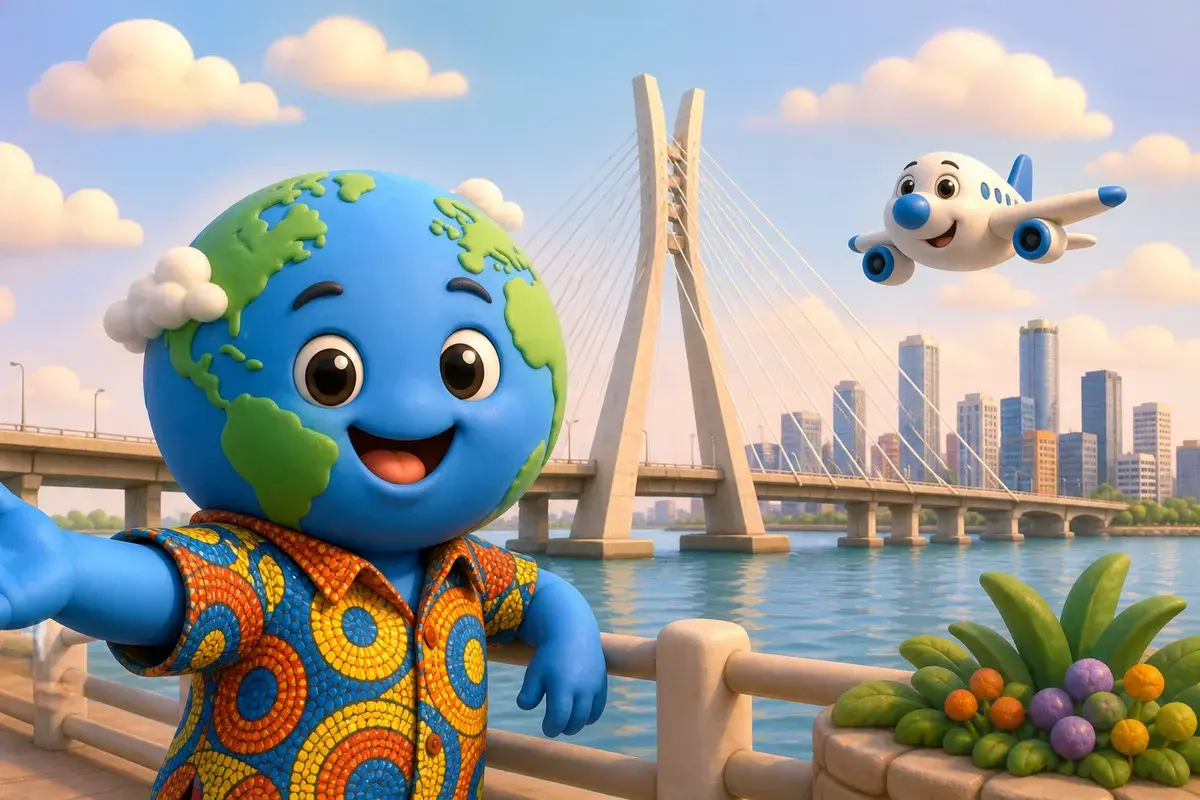
Lagos spreads across islands, sandbars and a very large mainland, all held together by a lagoon and a small number of bridges. It is the commercial engine of Nigeria and the loudest cultural exporter on the continent. The international airport lies 9 km from the middle of it.
Free — no account needed. The assistant builds a full proposal: itinerary, honest budget, map and booking links.
Why go
The geography is the first thing to understand, because it dictates everything else. Lagos Island holds the old commercial core and the great markets; Ikoyi and Victoria Island next door concentrate offices, galleries and restaurants; Lekki runs east along a narrow strip between lagoon and ocean; and the mainland, where most of the population actually lives, stretches away north across the water. Moving between those pieces means bridges, and bridges mean time.
People come for the culture rather than the sights. This is where Afrobeats is made, where Nollywood shoots, where a contemporary art scene has grown fast, and where a night out genuinely starts after midnight. Beaches exist, reached by boat across the harbour rather than by road. What Lagos does not offer is ease: it is expensive by regional standards, exhausting to cross, and demanding of anyone who dislikes crowds or noise. Those who take to it tend to come back, and those who do not usually knew within a day.
Month-by-month climate
Look at the annual figure and Lagos seems very wet: 1424.2 mm of rain. Look at how it is distributed and the city becomes more manageable, because almost all of it falls between March and November. June, the hardest month of all, reaches 331 mm spread over 22 of the year's 203 rainy days, October 206.9 mm over 27 and July 202.2 mm over 19. These are not showers; they are events that stop the city. December and January are the exception, at 15.7 mm and 13.2 mm, under daytime values of 34.6 °C and 35 °C, with nights around 24 °C; the warmest afternoons of all come just after, in February, at 35.1 °C, by which time the rain is on its way back. The heat then eases as the rain sets in: July falls to 29.4 °C and August to 29.5 °C, the coolest phase of the year, when the sky greys over — though August itself dips to 97.6 mm, a lull between the two peaks of the rains. Nights are remarkably stable whatever the season, holding between 23.6 °C and 25.4 °C from one end of the year to the other, so the only real variable you pack for is water.
| Month | Avg. high (°C) | Avg. low (°C) | Rainfall (mm) | Days ≥ 1 mm | Days ≥ 5 mm |
|---|---|---|---|---|---|
| Jan | 35.0 | 24.4 | 13 | 6 | 0 |
| Feb | 35.1 | 25.2 | 35 | 9 | 1 |
| Mar | 34.2 | 25.1 | 74 | 17 | 3 |
| Apr | 33.9 | 25.4 | 70 | 17 | 3 |
| May | 33.2 | 24.7 | 112 | 22 | 8 |
| Jun | 31.0 | 23.9 | 331 | 22 | 14 |
| Jul | 29.4 | 23.8 | 202 | 19 | 9 |
| Aug | 29.5 | 23.6 | 98 | 20 | 6 |
| Sept | 30.3 | 23.8 | 200 | 24 | 12 |
| Oct | 31.9 | 23.8 | 207 | 27 | 13 |
| Nov | 33.5 | 24.5 | 67 | 13 | 3 |
| Dec | 34.6 | 24.0 | 16 | 7 | 0 |
Source: Meteostat — Lagos (Nigeria) station, 15.8 km away, 3 sample years. Monthly totals rebuilt from daily averages. Data partly modelled (Meteostat, DWD/met.no).
When to go
December to early February is the clear choice: 15.7 mm in December and 13.2 mm in January, the two lightest months of the year, bright days, and a city that fills with returning diaspora for a festival season that runs through the holidays. The trade-off is 35 °C in the afternoon. August is a viable second window, cooler at 29.5 °C and, at 97.6 mm, much drier than the months on either side of it. June is the month to refuse outright.
What to see in 2, 4 and 7 days
In 2 days
- Start on Lagos Island at the old commercial core, then dive into Balogun market when you have the energy for it.
- Cross to Ikoyi and Victoria Island for the national museum, a gallery or two and lunch somewhere with air conditioning.
- Watch the sunset from the waterfront and let dinner run late; nothing in this city starts when you expect.
- Second day at the conservation centre in Lekki, where a canopy walkway crosses swamp forest inside the city.
- Finish with live music, which in Lagos means an Afrobeats venue that opens long after other cities have closed.
In 4 days
- One day on Lagos Island: the historic quarter, the markets, and the bridges that connect it to everything else.
- One day between Ikoyi and Victoria Island for museums, contemporary galleries and the restaurant streets around them.
- One day on the water: a boat out to Tarkwa Bay or one of the beach islands, which cannot be reached by road.
- One day west to Badagry, where the coastal slave route is documented at the point of departure itself.
- Keep two evenings clear, one for live music and one for a rooftop, and plan nothing early the next morning.
In 7 days
- Two days for the island districts: the old core, the markets, the museum, and the galleries of Victoria Island.
- One day on the mainland, which is where most of Lagos actually lives, works and eats, and which visitors skip.
- One day by boat to the sandbar beaches across the harbour entrance, taking the whole day rather than half.
- One day at the Lekki canopy walkway and the lagoon shore, early enough to see birds before the heat builds.
- One day west to Badagry for the slave route museums and the beach behind the town.
- Add a day inland towards Ibadan, a very different Nigerian city, reachable by road or by the airport 117 km away.
- Leave the final day unscheduled for traffic, a repeat visit, and a flight that you will want to reach early.
Getting there and around
Murtala Muhammed (LOS) is 9 km from the centre as the crow flies, but the transfer depends entirely on the bridges and can take far longer than the distance suggests: allow generous margins in both directions. Cotonou (COO) is 111 km west across the border in Benin, and Ibadan (IBA) 117 km north, both separate destinations rather than fallbacks. In the city, ride-hailing apps are the standard method for visitors, boats now run commuter routes across the lagoon and are worth using, and motorcycle taxis are restricted in many districts. A driver who knows the bridges is worth what he costs.
Nearest airports
- LOSMurtala Muhammed International Airport9 km from the centre
- COOCotonou Airport111 km from the centre
- IBAIbadan Airport117 km from the centre
Budget
Country price level compared with France : −68 %
Price index for restaurants and hotels, France = 1000, from European purchasing power parities. It is a country average: it says nothing about one hotel in particular.
Lagos is cheaper than France overall, at roughly a third of the same standard, but it is expensive for the region and the top end is genuinely costly. Between 60 and 150 € buys a good double room on the islands, less on the mainland; a restaurant dinner in Victoria Island runs 15 to 40 € for one person, while jollof rice and grilled fish from a local kitchen is a tiny share of it. Boats and ride-hailing are cheap. A car and driver for the day is the line that matters.
Common mistakes
- Planning three appointments in one day across the bridges. Two is ambitious, and evening traffic can swallow an entire afternoon.
- Arriving without a visa sorted well in advance. Nigerian entry formalities are strict and nothing about them is spontaneous.
- Booking June for a beach week. With 331 mm falling over 22 days that month, the boats and the sandbars are the first casualties.
- Assuming the mainland is off limits. It is where the food, the music and most of the city's life actually happen.
- Expecting the day to start early. Lagos works late, eats late, and treats a dinner ordered near midnight as an ordinary one.
Frequently asked questions
Is Lagos manageable for a first-time visitor?
Yes, with preparation. The practical difficulties are movement and orientation rather than anything dramatic: the city is vast, the bridges are choke points, and addresses are hard to interpret from outside. Most visitors settle on a base in Ikoyi or Victoria Island, use ride-hailing apps, and accept that two or three fixed points a day is a full programme. A local contact transforms the experience.
How do I reach a beach from the city?
By boat, in almost every case. The usable sand lies on the far side of the harbour entrance and on the sandbars beyond it, and the crossing takes minutes where the road takes hours. Boats leave from jetties on Victoria Island and Ikoyi, generally chartered for a group. The ocean here has strong currents, so choose the sheltered bays rather than the open surf.
When does the rain actually interrupt a trip?
In violent bursts, and often, from March to November. The city records 1424.2 mm a year across 203 days of rain, and the heaviest of those flood low-lying roads and stop traffic dead — October alone counts 27 rainy days, 13 of them above 5 mm. Outside that window the risk drops sharply: December and January take only 15.7 mm and 13.2 mm, on 7 and 6 days.
Updated on 21 September 2026