
Bled — Slovenia
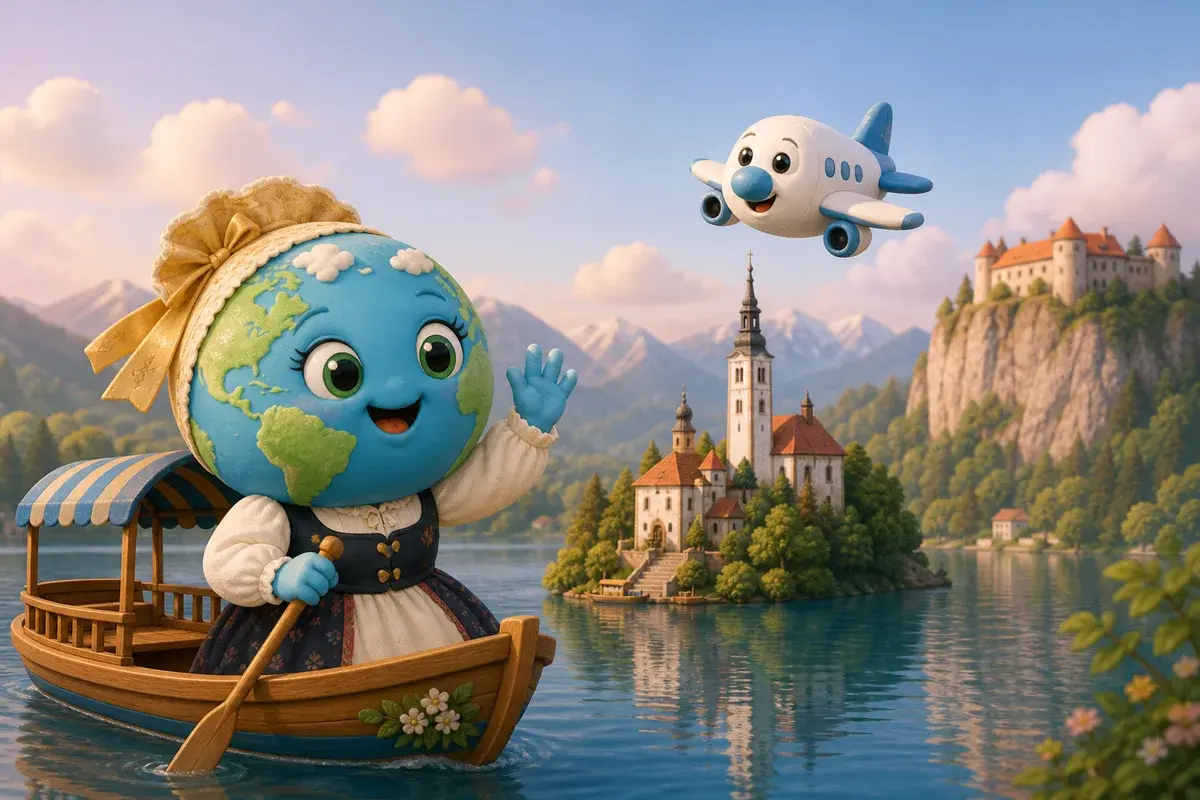
The neighbouring Bohinj valley, where we take our readings, collects 1,999.9 mm of rain a year — the highest annual total of any European destination in our catalogue. That single number reframes the postcard: this is an Alpine valley first, and a lake with an island church second.
Free — no account needed. The assistant builds a full proposal: itinerary, honest budget, map and booking links.
Why go
Bled is small and the geography does the work. A glacial lake holds one island, on which stands a church reached by flat-bottomed rowing boats; a castle sits on a cliff directly above the water; a level path runs the whole way round the shore, so the best of the place costs nothing and needs no skill. Just beyond, a river gorge is crossed by a walkway pinned to the rock, and behind that the Julian Alps rise into a national park. The town itself is functional rather than charming — hotels, a bus station, cake shops — worth knowing before you arrive expecting an old centre.
It suits walkers, families with small children who can manage a flat lakeside loop, and anyone who wants a comfortable base for the mountains without driving much. It suits badly those looking for nightlife, architecture or a city, and those allergic to crowds in July and August, when the shore path becomes a queue. Two nights cover the lake, the island and the castle. Four or five let you add the gorge, the second larger lake next door and a day in the national park, which is where Slovenia actually opens up.
Month-by-month climate
Two things define this valley: it is cold in winter and it is extraordinarily wet all year. January is the coldest month, 0.7 °C by day and −5.2 °C at night, and December and February are barely above freezing at 2.5 °C and 2.6 °C. Summer is mild rather than hot, peaking in August at 18.2 °C with July at 17.7 °C — a real argument for the lake in a heatwave. The rainfall is the headline. October tops the table at 296.8 mm across 13 rainy days, ahead of November at 200.9 mm and January at 188.3 mm. Even the driest months stay heavy: February records 115.1 mm over 8 days, December 122 mm over 9. Summer brings no relief in frequency — May has 20 rainy days for 215 mm and July 19 days for 134.7 mm. The annual figure reaches 1,999.9 mm on 162 rainy days. One local correction: our reference point sits higher, in the neighbouring valley, so the lakeshore itself is probably a shade milder and somewhat drier than these numbers suggest.
| Month | Avg. high (°C) | Avg. low (°C) | Rainfall (mm) | Days ≥ 1 mm | Days ≥ 5 mm |
|---|---|---|---|---|---|
| Jan | 0.7 | -5.2 | 188 | 10 | 7 |
| Feb | 2.6 | -3.7 | 115 | 8 | 4 |
| Mar | 3.1 | -3.4 | 142 | 11 | 7 |
| Apr | 5.6 | -0.8 | 160 | 14 | 7 |
| May | 9.8 | 3.7 | 215 | 20 | 12 |
| Jun | 17.2 | 9.5 | 117 | 16 | 8 |
| Jul | 17.7 | 10.5 | 135 | 19 | 9 |
| Aug | 18.2 | 10.4 | 131 | 17 | 9 |
| Sept | 13.5 | 6.5 | 177 | 14 | 8 |
| Oct | 10.4 | 4.2 | 297 | 13 | 9 |
| Nov | 5.0 | -1.3 | 201 | 11 | 7 |
| Dec | 2.5 | -3.8 | 122 | 9 | 5 |
Source: Meteostat — Lac de Bohinj (Slovenia) station, 8.1 km away, 5 sample years. Monthly totals rebuilt from daily averages. Data partly modelled (Meteostat, DWD/met.no).
When to go
June and September are the two sane choices. June is the driest summer month at 116.8 mm and still reaches 17.2 °C; September gives 13.5 °C and thinner crowds, at the price of 177 mm. July and August are warmest but bring 19 and 17 rainy days and the year's heaviest visitor pressure. Winter is genuinely cold — 0.7 °C by day in January — and the gorge walkway is seasonal.
What to see in 2, 4 and 7 days
In 2 days
- Walk the full loop of the lake on arrival, anticlockwise, before doing anything else. It sets the scale.
- Take a traditional rowing boat to the island church, then ring the bell inside as everyone does.
- Climb to the cliff castle late in the afternoon, when the light comes down the valley and the coaches have gone.
- Eat the local cream cake once, in the afternoon, because it is genuinely a local institution and not an invention.
- Second morning at the river gorge nearby, early, before the walkway fills with single-file traffic.
In 4 days
- First day on the water's edge: the full shoreline circuit on foot to grasp the scale, then a traditional rowing boat out to the island church and its bell.
- Second day for the cliff castle in late-afternoon light, the river gorge next door at opening time, and a swim from the public bathing area if the season allows.
- Third day at the larger, quieter lake in the next valley, with a cable car to the ridge above it.
- Take the local bus rather than driving: parking near both lakes is restricted and expensive in high season.
- Fourth day walking a marked trail in the national park, chosen by weather rather than ambition.
- Keep an evening for the old market town a short bus ride away, which has the historic centre Bled lacks.
In 7 days
- Days 1 to 3 for the lake, the island, the castle and the gorge, unhurried and weather-driven.
- Day 4 in the next valley: the second lake, the waterfall at its head, the cable car for the panorama.
- Day 5 on a mountain pass road or a full day hike in the national park, with a serious rain plan.
- Day 6 down to the emerald river valley on the other side of the range, for rafting or a war-history museum.
- Day 7 in the Slovenian capital, reached by train or bus down the valley, for a city day before the flight home.
- Pack for rain on every single day. With 162 rainy days a year, a dry week is luck, not planning.
Getting there and around
The access here is unusual: three airports in three countries within 80 km. Ljubljana airport (LJU) is 30 km away and the natural choice, with buses and shuttles to the lake. Klagenfurt (KLU) in Austria is 35 km, and Trieste (TRS) in Italy 78 km, both of which can be cheaper and are worth checking. A rail line and regular buses connect Bled to the capital. On the spot you need no car for the lake — the shore path is walkable and buses serve the gorge and the next valley — but a car helps for the national park.
Nearest airports
- LJULjubljana Joze Pucnik Airport30 km from the centre
- KLUKlagenfurt Airport35 km from the centre
- TRSTrieste - Friuli Venezia Giulia Airport78 km from the centre
Budget
Country price level compared with France : −18 %
Price index for restaurants and hotels, France = 1000, from European purchasing power parities. It is a country average: it says nothing about one hotel in particular.
Slovenia is a genuinely cheaper country than France. Bled, however, is its most visited resort, and lakeside prices sit well above the national line, especially in July and August. Water frontage is what you pay for: on the lake a comfortable double asks between 70 and 140 €, less a few streets back, while meals take 30 to 55 € per person per day. The lake path, the shore and the mountain trails cost nothing at all, and that free half of the day is what keeps the overall figure reasonable.
Common mistakes
- Planning a dry summer week. May sees 20 rainy days and July 19: build the itinerary so that rain changes the order, not the trip.
- Staying a single night. Bled read in one afternoon is a photo stop; the gorge and the next valley are what justify the journey.
- Driving up to the castle or the gorge in high season and losing an hour to parking that is restricted and full.
- Skipping the larger lake in the next valley because the famous island is here. It is quieter, wilder and free.
- Arriving in winter expecting the gorge walkway: it is seasonal, and January averages 0.7 °C by day.
Frequently asked questions
Is Bled too touristy to be worth it?
In the middle of a July day, yes — the shore path is dense and the island boats queue. Early morning and late afternoon are a different place entirely, and September thins the crowd noticeably while keeping 13.5 °C. The lake is small, so the pressure is concentrated in hours rather than spread across the season.
Bled or Bohinj?
Bled has the island, the castle and the infrastructure; Bohinj, in the next valley, is larger, wilder, inside the national park and much quieter. Our climate reference point actually sits over there, 8.1 km away. If you have two nights, stay at Bled and visit Bohinj. If you have four and you walk, consider doing the reverse.
Is a car necessary at Bled?
Not for Bled itself. The lake loop is on foot, buses reach the gorge, the next valley and the capital, and parking near the water is restricted and costly in season. A car earns its place only if you intend to drive a mountain pass or reach trailheads in the national park at your own hours.
Updated on 21 September 2026