
Stockholm — Sweden
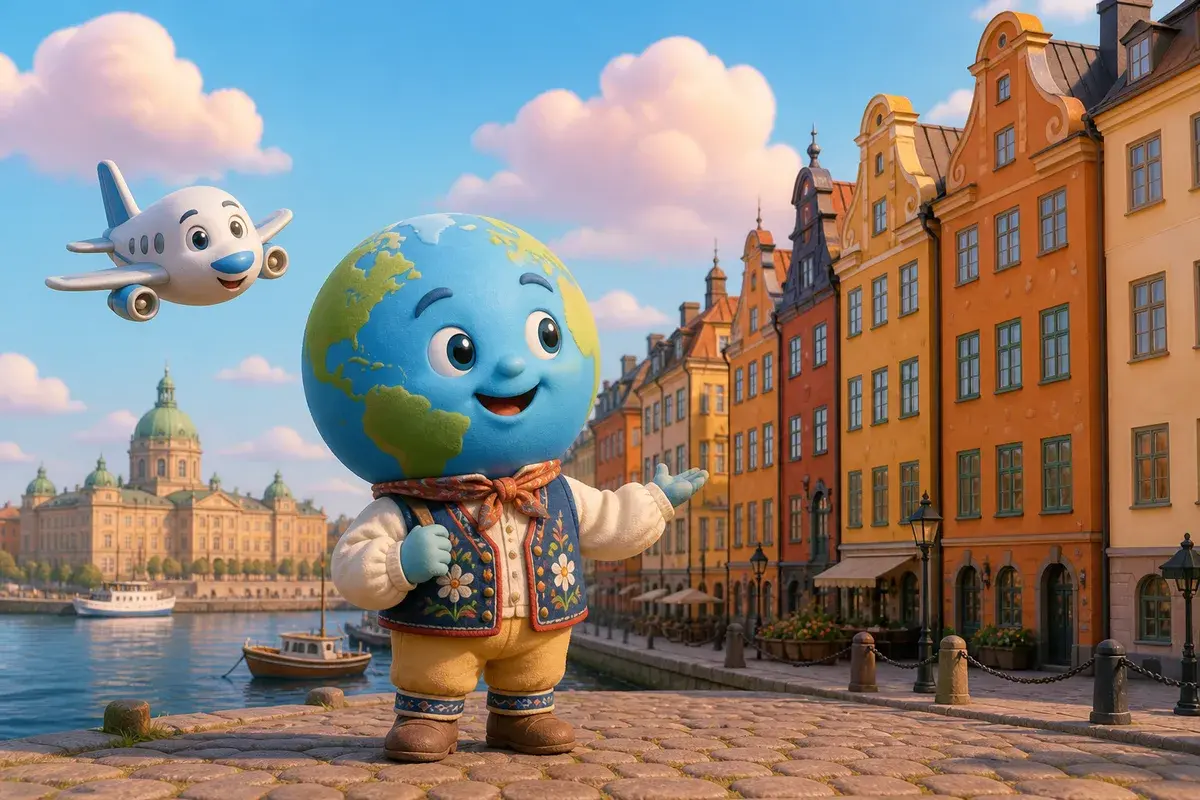
Here is the figure nobody expects from a Nordic capital: Stockholm collects 426.8 mm of rain a year, less than Barcelona at 564.1 mm and less than Madrid at 464 mm. What the city lacks between November and February is not rain — it is daylight. The rest is water, islands and ferries.
Free — no account needed. The assistant builds a full proposal: itinerary, honest budget, map and booking links.
Why go
Stockholm is built where a lake empties into the Baltic, across the islands that clog the passage. That fact organises everything: you cross a bridge every few hundred metres, ferries are public transport, and the horizon at most street ends is water, not buildings. The old town is one small island of ochre facades and lanes, a palace at one end; the museum district has a green island of its own; the archipelago begins where the quays end, not an hour's drive away. Swedish design is not a souvenir category here: it is in the metro stations, the furniture of ordinary cafés, the light fittings of the public library.
It is made for people who like museums with one strong subject, boats, and cities read by neighbourhood: the old island for history, the southern island for second-hand shops and viewpoints, the museum island for a full day. It is made much less for tight budgets, and not at all for those needing winter light — in January the temperature tops out at 1.1 °C and the afternoon ends early. Three days cover the city. Five let you sleep out in the archipelago, where Stockholm stops being a capital.
Month-by-month climate
A continental winter and a short, bright, remarkably dry summer. The coldest stretch falls in January, 1.1 °C by day and −3.8 °C at night, with February at 2.2 °C — a frozen-harbour climate rather than a damp one. Warming comes late and fast: 10.1 °C in April, 17.1 °C in May, then 21.6 °C in June and 22.4 °C in July, the warmest month, with nights at 14 °C. On rain, the numbers are low across the board. May is the driest month at 19 mm over 4 rainy days, and September matches that day count with 28.8 mm. June, July and August sit at 28.3 mm, 46.3 mm and 28.8 mm. The wettest month, October, only reaches 57.8 mm over 7 days, and December follows with 52 mm over 11. The annual total is 426.8 mm across 86 rainy days — one of the lowest day counts in northern Europe within our catalogue.
| Month | Avg. high (°C) | Avg. low (°C) | Rainfall (mm) | Days ≥ 1 mm | Days ≥ 5 mm |
|---|---|---|---|---|---|
| Jan | 1.1 | -3.8 | 49 | 11 | 2 |
| Feb | 2.2 | -2.9 | 32 | 7 | 2 |
| Mar | 5.7 | -1.4 | 31 | 7 | 2 |
| Apr | 10.1 | 1.9 | 22 | 6 | 1 |
| May | 17.1 | 6.5 | 19 | 4 | 1 |
| Jun | 21.6 | 11.4 | 28 | 6 | 2 |
| Jul | 22.4 | 14.0 | 46 | 7 | 3 |
| Aug | 21.0 | 13.1 | 29 | 8 | 2 |
| Sept | 18.6 | 10.2 | 29 | 4 | 2 |
| Oct | 10.9 | 4.9 | 58 | 7 | 3 |
| Nov | 5.2 | 0.2 | 33 | 8 | 1 |
| Dec | 1.7 | -2.6 | 52 | 11 | 2 |
Source: Meteostat — Stockholm (Sweden) station, 7.1 km away, 3 sample years. Monthly totals rebuilt from daily averages. Data partly modelled (Meteostat, DWD/met.no).
When to go
Late May to early September, with May and September as the connoisseur's choices: both record only 4 rainy days, and May adds the year's lowest rainfall, 19 mm, at 17.1 °C. June and July are warmest at 21.6 °C and 22.4 °C, with evenings that barely go dark. July is peak holiday season — boats are full and part of the city closes for the summer. Avoid December for light, not for rain.
The most favourable months, on these records
- June
- July
- August
What to see in 2, 4 and 7 days
In 2 days
- Start on the old-town island early, before the coach groups, then the palace and the cathedral beside it.
- Cross to the city hall for the tower view and the hall where the Nobel banquet is held.
- Afternoon on the museum island for the salvaged seventeenth-century warship, which deserves two unhurried hours.
- Take a commuter ferry rather than a sightseeing boat: same water, public transport fare, local passengers.
- Second day on the southern island for viewpoints over the water, design shops and a long coffee break.
In 4 days
- Day one on the old-town island — palace, cathedral, the lanes before the coach groups — then the city hall tower.
- Day two split between the museum island, for the salvaged seventeenth-century warship, and the open-air museum on the green island beside it.
- Third day riding the metro for its decorated stations, treating the network itself as the gallery, with an afternoon on the southern island.
- Fourth day out into the archipelago by scheduled boat, choosing one island and staying there all day.
- Buy a multi-day transport card on arrival: metro, buses and commuter ferries share the same ticket.
- Keep one afternoon for a single strong museum — photography, maritime history or northern peoples — rather than three.
In 7 days
- Days 1 to 3 for the city islands, at a walking pace, with one museum a day and no more.
- Day 4 at the royal palace on its lake island west of the city, reached by boat in good weather.
- Day 5 by train to a nearby cathedral city or a small lake town, for a completely different scale.
- Days 6 and 7 sleeping out in the archipelago: one boat out, one island, cold water, and the way back.
- Check boat timetables before planning archipelago nights: services thin out sharply outside high summer.
- Reserve one grey afternoon for the public library and a long fika, which is a local institution rather than a habit.
Getting there and around
Bromma (BMA) is the closest airport at 8 km, linked by bus and used mainly for domestic and short-haul flights. Arlanda (ARN) at 37 km handles most international traffic and is connected by a fast train and by coaches to the central station. Västerås (VST), 86 km out, appears on some low-cost schedules and is not, in practice, Stockholm — check the transfer time before booking. In the city, one travel card covers metro, buses and commuter ferries, which are ordinary public transport here. Most of the centre is walkable if you accept the bridges.
Nearest airports
- BMABromma Airport8 km from the centre
- ARNStockholm Arlanda Airport37 km from the centre
- VSTVasteras/Hasslo Airport86 km from the centre
Budget
Country price level compared with France : +6 %
Price index for restaurants and hotels, France = 1000, from European purchasing power parities. It is a country average: it says nothing about one hotel in particular.
Sweden costs more than France, though not by the margin its reputation suggests, and Stockholm runs above its own national figure. There is little below 110 € a night for a decent double room, and the range tops out around 200 €; food runs 45 to 85 € a head daily. The lever that works is lunch: weekday set menus are a national habit and cost a fraction of the same restaurant at dinner. Card payment is accepted everywhere and cash has all but disappeared, so carrying notes serves little purpose.
Common mistakes
- Booking a flight to the airport 86 km out and discovering the transfer costs more time than the flight saved.
- Treating ferries as tourist boats. They are public transport on your travel card, and they are the best way to see the city.
- Planning an archipelago day in April or October without checking timetables, when many scheduled services stop.
- Coming in December for the light rather than for the darkness and the markets. January peaks at 1.1 °C by day.
- Eating dinner every night at restaurant prices instead of using the weekday lunch menus that locals rely on.
Frequently asked questions
Is Stockholm as rainy as other Nordic capitals?
No, and the gap is large. The figures give it 426.8 mm a year over 86 rainy days, which is less rain than Barcelona or Madrid receive. May alone drops to 19 mm over 4 days. The Nordic difficulty in winter is darkness and cold, not precipitation — January tops out at 1.1 °C by day.
Do I need to go out to the archipelago?
If you have more than three days, yes. The city already sits on water, but the archipelago is a different register — bare rock, wooden houses, cold swimming, silence. One scheduled boat and one island is enough; you do not need a tour. Check the season, because timetables thin out considerably outside high summer.
Which island should I stay on?
The old town is atmospheric but small, noisy in summer and short on ordinary life. The southern island is where most visitors are happiest: viewpoints, cafés, second-hand shops, metro connections and lower prices. The central mainland district is the practical choice for transport and shopping, and everything is a bridge or two away in any case.
Updated on 21 September 2026